
At Floraveld,
science is the foundation
of how we understand materials,
evaluate technologies and develop environmental solutions.
We combine published research, engineering knowledge, technical expertise and the experience of our strategic and scientific partners to identify technologies that can deliver meaningful environmental outcomes.
From Environmental Challenge to Material Science
Our search for practical nature-based solutions led us to coir. What began with a familiar natural fibre developed into a deeper understanding of its potential through our work with Dr. Anil Kunnath Rajan. and the Indian research community, particularly the institutions and expertise rooted in Kerala’s long-standing coir and agricultural research ecosystem. Its applications in soil conservation, engineering, water management and environmental restoration became a natural foundation for Floraveld’s technology strategy.
The Science of Coir
A Natural Material with Engineering Potential
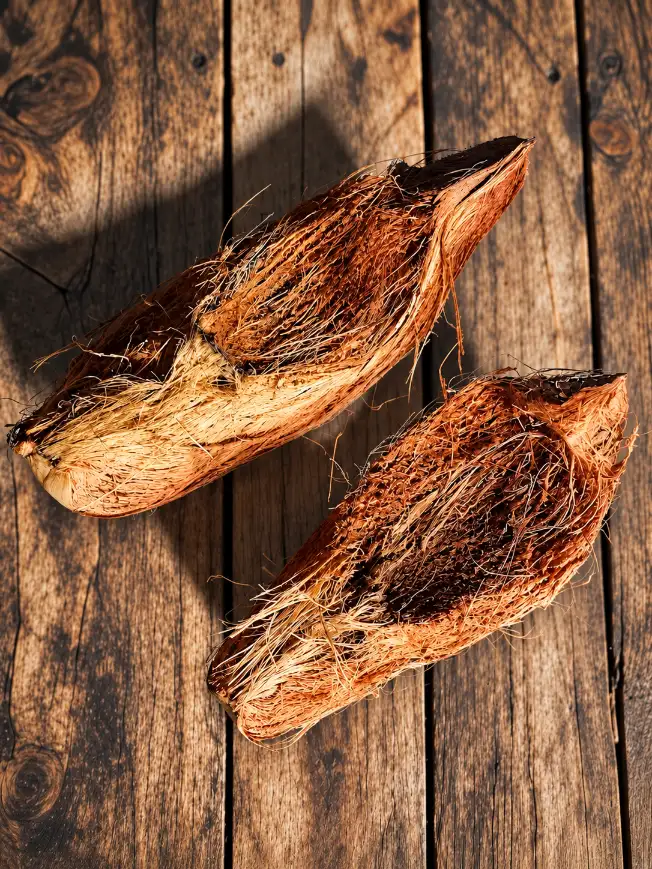
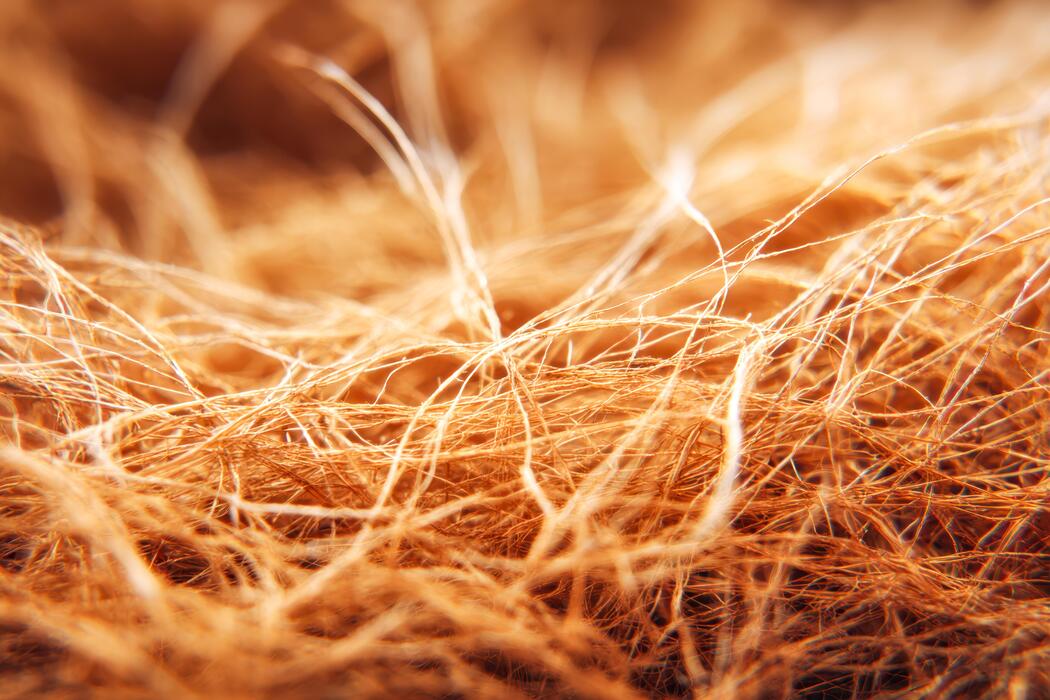
Coir is the natural fibre extracted from the husk of the coconut (Cocos nucifera). Coir is a natural fibre with a long history of research and application in soil and water conservation.
High lignin content (~40–45%)
Resists microbial and enzymatic breakdown better than most natural fibres.
Regulated, staged biodegradability
Geotextile mats persist roughly 2–5 years, coir logs/rolls roughly 3–5 years, degrading only after root systems mature, then converting to soil organic matter.
High water-holding capacity with high porosity/aeration
holds up to roughly 9 times its dry weight while retaining free drainage and root respiration.
Near-neutral pH (6.0–6.8)
compatible with a wide range of native soils and species without amendment.
High cation exchange capacity (CEC)
buffers and slow-releases nutrients (K⁺, Ca²⁺, Mg²⁺) rather than letting them leach.
Mechanical/tensile strength from the fibre matrix
binds soil particles and dissipates the kinetic energy of flowing water, waves, and rainfall.
Contaminant/heavy-metal sorption
hydroxyl, carboxyl, and phenolic surface groups bind metal cations from soil and water.
Renewable, non-synthetic, by-product sourcing
derived from existing coconut processing rather than extraction or synthetic manufacture.
Our Research & Technology Ecosystem
Scientific Leadership
Dr. Anil Kunnath Rajan.
Scientific Advisory Lead
Floraveld's scientific direction is supported by Dr. Anil Kunnath Rajan., a soil conservation engineer and agricultural engineering specialist whose career spans academic research, institutional leadership and applied technology development.
Dr. Anil holds a PhD in Soil Conservation Engineering from Cochin University of Science & Technology, along with M.Tech and B.Tech qualifications in Agricultural Engineering. He has served as Professor & Head of the Department of Agricultural Engineering at Kerala Agricultural University and as Director of the National Coir Research and Management Institute in Thiruvananthapuram.
During his tenure at the National Coir Research and Management Institute, his work included the development of technologies involving coir geotextiles, cocologs, coir geocells, erosion control, riverbank and pond stabilisation, road and earthen-bund construction, shoreline protection, coir composites and other coir-based applications.
His research portfolio also includes extensive publications and technical presentations covering coir geotextiles, slope stabilisation, riverbank protection, soil and water conservation and sustainable land management.
His professional contributions have been recognised through multiple national and state-level awards, including a Lifetime Achievement Award in the field of coir geotextiles from the Coir Board in 2023.
As Scientific Advisory Lead, Dr. Anil provides scientific and technical oversight to Floraveld's technology strategy, research relationships and evaluation of nature-based engineering technologies.
Publications
'Lignocellulosic materials as reinforcement and replacement for binders in masonry mortar’, Elsevier, Construction and Building Materials, 282 (2021) 122607.
‘Use of coir geotextiles for soil and water conservation: Case studies from India, technological interventions in management of irrigated agriculture Part III: engineering interventions for soil and water conservation’, published by AAP Apple Academic Press Waretown, NJ 08758 USA, February 2018
‘Participatory research using coir geotextiles in watershed management – A case study in South India’, Physics and Chemistry of the Earth 33 (2008) 41- 47.
‘Sustainability analysis of two participatory watershed projects in Kerala’, Physics and Chemistry of the Earth 33 (2008) 1-12.
‘The protective and attractive covering of a vegetated embankment using coir geotextiles’, Hydrol.Earth Syst. Sci. 10, 565-574, 2006.
‘Experiment study using coir geotextiles in watershed management’, Hydrol.Earth Syst. Sci. Discuss.,2,2327-2348, 2005.
Strategic Technology Partner
With more than two decades of expertise in natural-fibre geoproducts and soil bio-engineering, Geonet brings proven technical knowledge across the development, engineering and application of natural-fibre solutions.
Its expertise encompasses erosion control, slope and embankment protection, riverbank protection, road construction and ground improvement—providing a strong technical foundation for Floraveld’s nature-based solutions.
Through our strategic relationship with Geonet, this established expertise is connected with European environmental applications. The collaboration supports the evaluation, adaptation and development of coir-based technologies to meet project-specific conditions, while facilitating knowledge exchange between established soil bio-engineering practice and evolving European requirements.
Institutional Partnerships
Floraveld maintains formal relationships with established organisations across the coir and natural-fibre sector. These partnerships provide access to manufacturing capabilities, sector expertise, technical resources and industry networks, strengthening the connection between Floraveld’s European activities and the wider coir ecosystem at source.
Scientific & Technical Network
Our wider network brings together researchers, engineers, technical specialists and knowledge institutions working across coir-based and other nature-based technologies. Their expertise supports technical research, product evaluation and knowledge exchange, helping advance practical solutions for environmental restoration, infrastructure resilience and sustainable resource use.
Innovation through Collaboration
We believe meaningful innovation is often collaborative.
Many of the technologies and applications relevant to Floraveld have been developed through the research, engineering and manufacturing capabilities of our strategic and collaborating partners.
Our role is to identify technologies with genuine potential, understand the science behind them, evaluate their relevance and integrate them into practical solutions for specific environmental challenges.
This can mean:
- adapting established technologies to new applications;
- combining different materials or systems;
- translating research into project-specific engineering solutions;
- identifying opportunities for new European applications;
- improving how natural materials are incorporated into infrastructure; and
- connecting researchers, manufacturers, engineers and end users.
Innovation, for us, is not about claiming ownership. It is about creating value from knowledge.
Looking Ahead
Environmental challenges are evolving.
Floraveld will continue working with researchers, engineers, manufacturers and strategic partners to explore emerging materials, improve existing applications and identify new opportunities for nature-based engineering.
Our objective is not innovation for its own sake.
It is better environmental performance, supported by better knowledge.
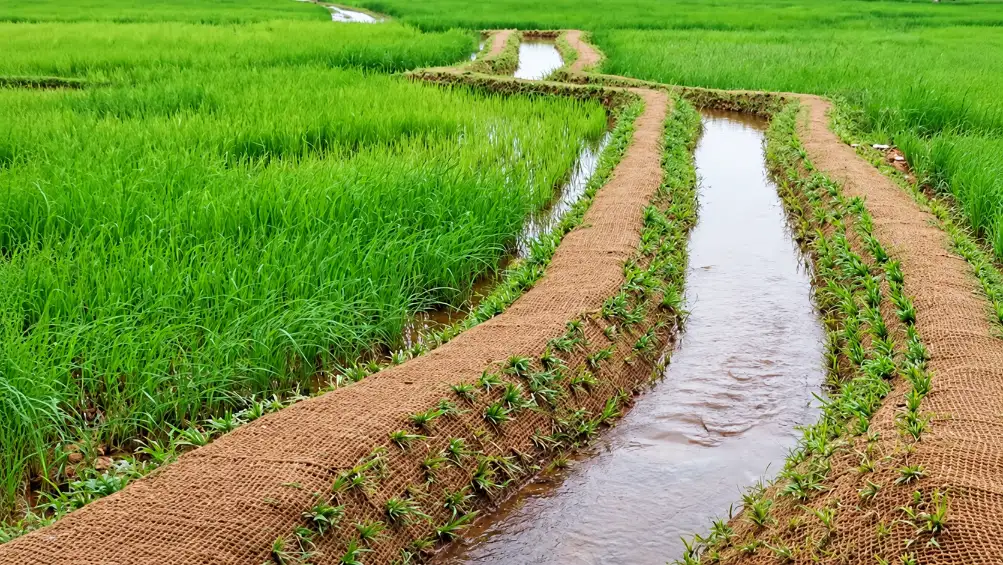


Coir is an important part of Floraveld's current technology portfolio
But it is not our limitation.
As scientific understanding evolves, we will continue to evaluate new materials, technologies and engineering approaches that can improve environmental performance.